A recessed downlight looks like a simple thing to specify and turns out to have about ten decisions in it. Make them in the wrong order and you end up with a fixture that fits the ceiling but not the room, or lights the room but flickers on the dimmer. Here is the order we make them in, with what each one depends on. Layout and spacing are a separate step, covered in our guide to downlight layout; this piece is about the fixture.
1. What the fixture is for
General light across the floor, task light on a surface, or accent light on a feature. This decides nearly everything below: a general fixture wants a wide beam and a fixed engine, a task fixture a medium beam placed over the work, an accent fixture a narrow beam and an adjustable engine. A schedule that lists one downlight type for the whole house has skipped this step.
2. Aperture
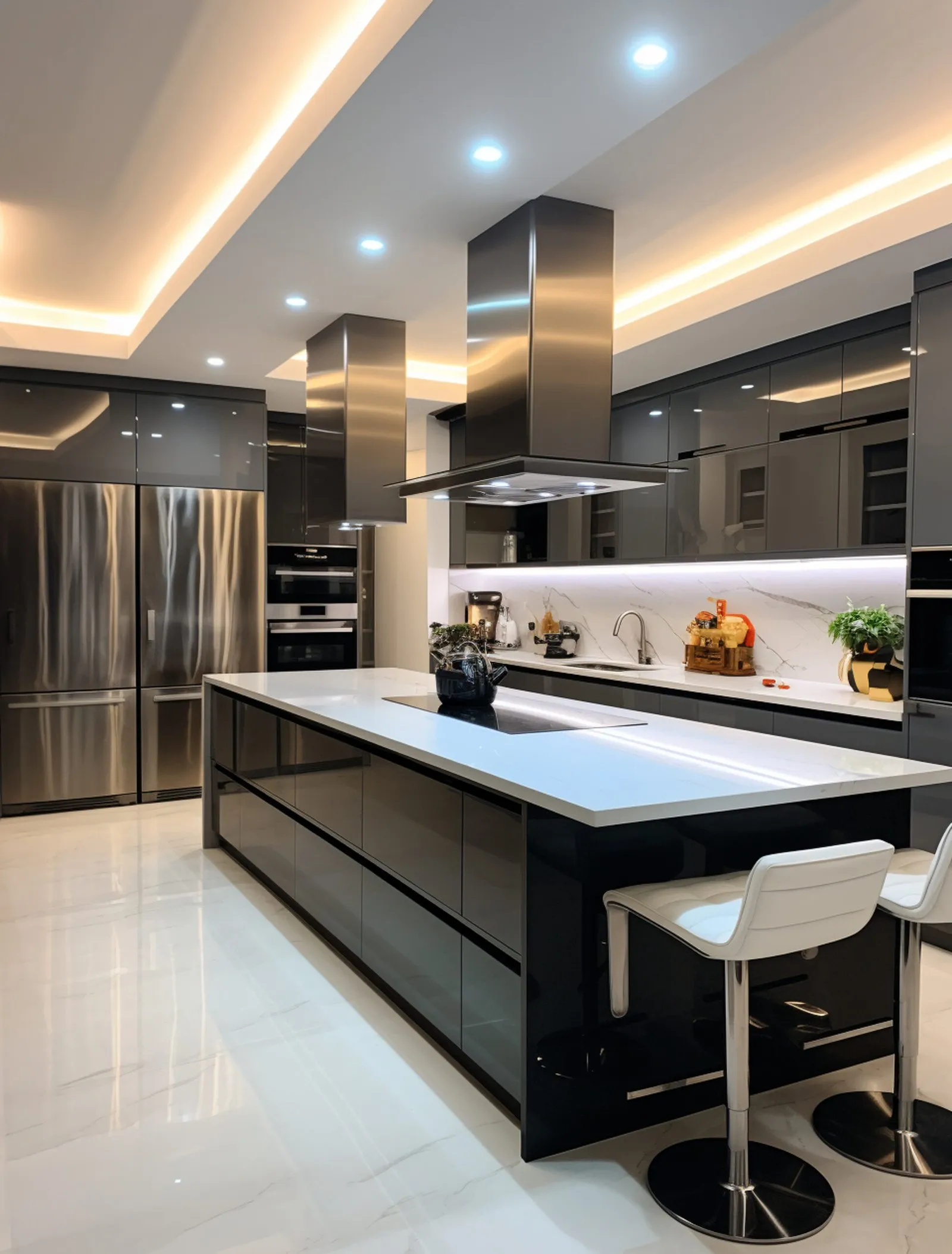
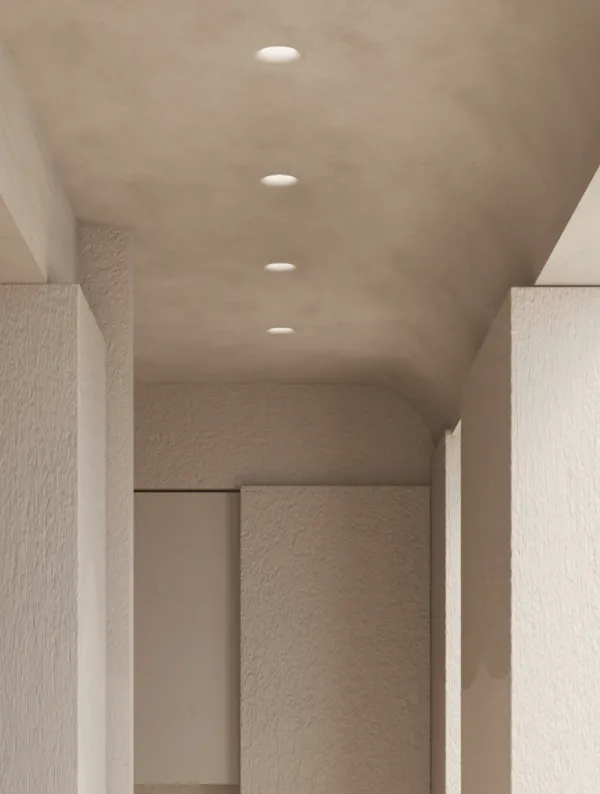
The size of the hole in the ceiling is the fixture's visible footprint, and smaller is better for the ceiling, within the limits of output. A 3 inch cutout is the residential workhorse: enough room for a 15 watt chip and a proper reflector, small enough that a row of them reads as dots rather than holes. A 1 inch aperture suits bedrooms, corridors and formal rooms where the ceiling should stay quiet, with less output per point and therefore more points. A pinhole under half an inch is for the ceiling that must not be seen to have anything in it. The old 4 and 6 inch cans are for retrofits into their own holes and not much else.
3. Fixed or adjustable
Fixed engines point straight down and are the right choice for general and most task fixtures. Adjustable engines tilt, 20 degrees in ours, and rotate a full 360, so the fixture can be aimed at a wall, a bookcase or a piece of art after the ceiling is closed. Specify adjustable only where something needs aiming; an adjustable fixture aimed straight down is a fixed fixture that cost more and has a less tidy aperture. Note that on our range the adjustable engine is the IP20 version, and the IP44 and IP65 versions are fixed.
4. Trim
Three options. Trimless: a plaster frame set before the skim coat, so the finished ceiling shows only the aperture with no ring. The quietest result and the one that needs the fixture on site before the plasterer. Micro-flange: a visible edge a couple of millimeters wide that covers the cut and forgives a slightly ragged hole, the practical choice in drywall. Millwork: a trim designed to sit in joinery, for a downlight in a canopy bed, a wardrobe or a kitchen cabinet base. Round or square is decided with the trim, and it does not affect the light.
5. Beam
Our downlights run from 15 to 80 degrees. The pool a beam makes on a surface is about twice the distance multiplied by the tangent of half the angle, so from a 9 foot ceiling a 15 degree beam covers about 2.4 feet, 25 degrees about 4 feet, 50 degrees about 8.4 feet. Narrow beams for accents on objects, 25 to 35 for a painting or a counter, 50 to 80 for the general layer. A schedule with one beam for everything produces a flat room.
6. Color temperature and engine
Static color temperatures: 2700K for living rooms, bedrooms and dining rooms, 3000K for kitchens and bathrooms, 3500K and 4000K for a home office or a workshop that is not seen from the rest of the house. One temperature per sightline. Then decide whether the fixture should change: a dim to warm engine drifts from 3000K to 1800K as it dims, and a tunable engine runs from 2700K to 6500K under a control system. Dim to warm on the living and dining general layer is the most common upgrade on our schedules; tunable white belongs in bedrooms and offices where the control will actually drive it.
7. Color rendering
90 CRI is the floor for a room people live in. 95 or better where there is timber, stone, fabric or skin under the light, which is most rooms. Ask for the R9 value as well, since the standard eight-sample test misses saturated red and a chip can score 85 while making terracotta look brown. Our static engines run at 97 CRI; the dim to warm and tunable engines at 95.
8. Ingress rating
IP20 for dry rooms, which is everywhere except the bathroom and outside. IP44 over a vanity or in a bathroom outside the shower zone. IP65 inside a shower, under a covered exterior soffit, or anywhere that gets hosed down. Rating above what the location needs costs a little and buys nothing; rating below it fails an inspection.
9. Driver
The driver has to match the dimmer, and this is where most flickering downlights went wrong. TRIAC, also called phase cut or mains dimming, works behind a standard LED-rated wall dimmer and is the simplest path in a house. 0-10V is the wired commercial standard and suits a control system. DALI-2 gives each fixture an address for scene control and per-fixture adjustment. Casambi is wireless, controlled from a phone or a keypad with no central hardware. A remote driver, mounted away from the fixture in an accessible spot, suits shallow ceilings and makes a future replacement a ten minute job. Decide the protocol for the whole house, then the driver for each fixture.
10. Housing and listing
Where the fixture meets insulation, which is most ceilings under a roof, the housing must be IC rated. Where the void is open and uninsulated, a non-IC housing or a flat bracket is enough. Confirm the listing for the market, ETL or cETL in North America, and that the fixture comes with an IES photometric file so the layout can be calculated rather than estimated. For a retrofit into a finished ceiling, ask which housing suits it before ordering.
The order, written out
- Job: general, task or accent
- Aperture: 3 inch, 1 inch or pinhole
- Fixed or adjustable
- Trim: trimless, micro-flange or millwork; round or square
- Beam: 15 to 80 degrees by job
- Color temperature, and static, dim to warm or tunable
- CRI and R9
- IP rating by location
- Driver by dimming protocol
- Housing by insulation, and listing
That is the fixture. The count, the spacing and the positions are the layout, which is the next step, and the one our lighting design service draws with the light levels calculated from the fixture's own photometrics. Send us the plan and the answers to the first three questions above, and we will return the rest.
Planning a project? Our lighting design service turns plans into a photometric plan, fixture schedule, and final aim. Start with a design brief.